
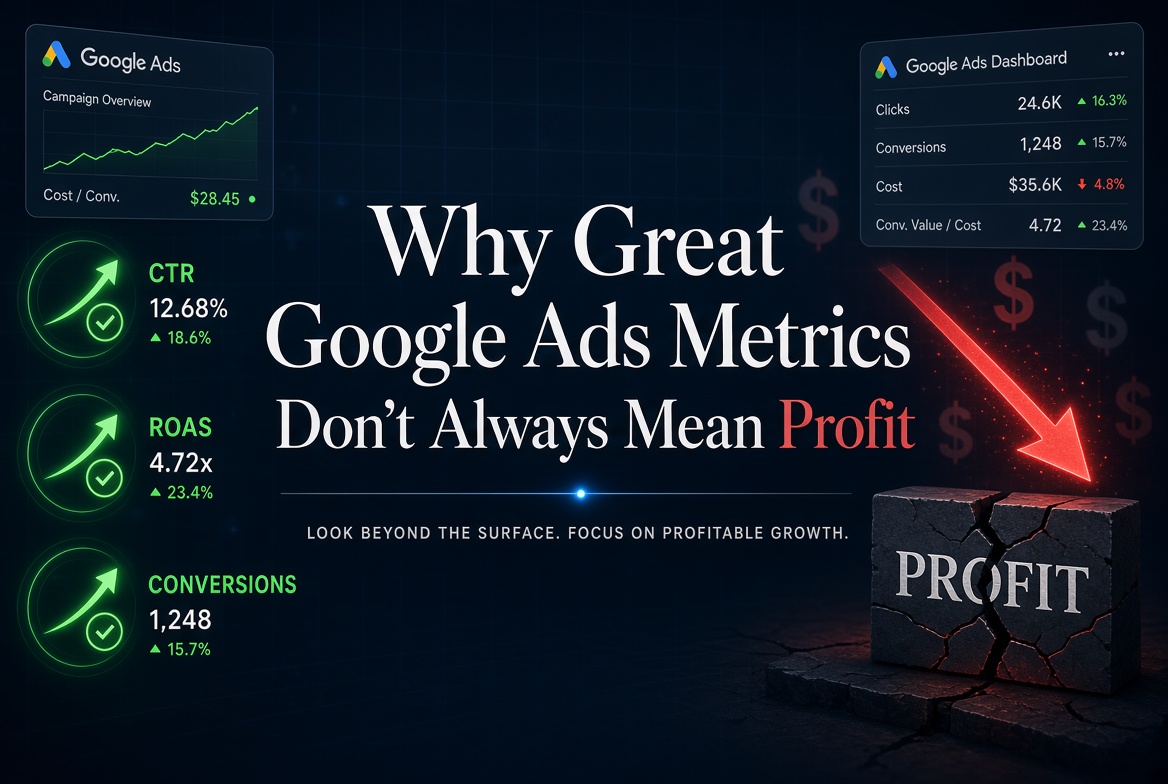
The dashboard looks great. Clicks are up, impressions are climbing, and ROAS is hitting targets. So why isn’t the business actually making money? The divergence between ad metrics and actual profit comes down to what those metrics measure.
Impressions, clicks, CTR, and even ROAS are activity and revenue metrics. They tell you what happened inside the ad platform, not what landed in the bank. A 4:1 ROAS sounds strong until you factor in cost of goods, shipping, returns, and overhead — at which point that “winning” campaign can quietly bleed margin. In one documented case, an advertiser with a 700% ROAS was actually 30% less profitable than a competitor running at “only” 400%. The numbers on the dashboard and the numbers in Shopify or QuickBooks can diverge by thousands of percentage points. That gap isn’t a rounding error. It’s the difference between scaling a business and scaling a problem.
The Hidden Cost of Bad Product Feed Data
Google Shopping doesn’t use keywords — it uses the feed. That single architectural difference is where most profit leaks happen. When product attributes are incomplete, inaccurate, or duplicated, Google can’t match products to the right queries. The result: spend goes toward clicks that were never going to convert.
A 2026 Product Feed Quality Index measuring 12,375 products across 251 stores found that 81.3% had no GTIN or MPN, and 68% of titles exceeded 80 characters — while Shopping ads display roughly 70. These discrepancies explain why a well-funded campaign with strong ROAS can still underperform on actual margin.
Out-of-stock items still being advertised represent pure waste. If 15% of a store’s inventory is unavailable and the feed doesn’t reflect that, 15% of the budget is gone. At $3,000/month in spend, that’s $450 every single month, compounding silently while the dashboard shows green.
How Poor Feed Data Undermines Automated Campaigns
Performance Max can’t fix bad data — it amplifies it. When product attributes are missing, inaccurate, or generic, automation doesn’t compensate; it learns slower and scales inefficiently. Automated bidding algorithms like Target ROAS treat all products equally by default, which creates a specific danger: the algorithm finds it easier to generate sales on low-margin products and pours budget into them. Revenue climbs. The bank balance shrinks.
Most of this traces back to a feed that was configured once and never touched again. Disapproved products, missing GTINs, weak titles, stale inventory data — all fixable, none of them fixed.
Google scans title, description, product type, and attributes to decide which searches trigger a product. A title like “Brown Adirondack Chair” competes very differently than “Brown Adirondack Chair, Weather-Resistant Solid Wood, Outdoor Patio.” One client with generic titles had impression share stuck at 35%; after feed optimization — no bid changes — it reached 68% within three weeks.
Using Custom Labels for Margin Segmentation
Custom labels (custom_label_0 through custom_label_4) segment inventory by margin, seasonality, performance tier, and price range. Without them, a $400-margin product and a $10-margin product compete for the same budget under the same bid strategy.
That’s where the real profit gap opens. A 6x ROAS on a 15% margin product is not the same business outcome as a 6x ROAS on a 60% margin product — yet the dashboard treats them identically. Custom labels create distinctions Google’s taxonomy never will: high-margin bestsellers in one campaign with an aggressive ROAS target, new products in a learning phase in another, clearance stock on manual CPC in a third.
The feed-level payoff is measurable. Accounts with a feed quality score above 80% see 15% lower CPCs on average. A well-structured feed expands Shopping impression share by 40–60% without touching a single bid.
Turn Feed Optimization Into Profit With AdFlow
AdFlow transforms product feeds into high-performance sales drivers by eliminating manual data entry. Using AI-powered optimization, AdFlow automatically enhances titles, descriptions, and missing attributes through dynamic custom labeling and real-time mapping. Seamlessly synced with Google Merchant Center and Google Ads, it keeps inventory organized through automated custom labels while detecting and filling missing attributes like color and material instantly.
Stop letting poor feed data drain your ad budget. With AdFlow, you can launch high-performing shopping campaigns directly from your Shopify dashboard in minutes — and finally close the gap between dashboard metrics and real profitability.
Stop leaving profit on the table with a broken product feed.
Every disapproved product, missing GTIN, and unoptimized title is quietly draining your Google Shopping budget — and no amount of bidding strategy can fix bad data. That’s where Adflow comes in. Powered by AI, Adflow automatically optimizes your titles, descriptions, and missing attributes, keeping your feed perfectly synced with Google Merchant Center in real time. Whether you’re fighting impression share loss or scaling a Performance Max campaign, a clean, optimized feed is the foundation. Take control with Google Merchant Center feed management and turn your product data into your biggest competitive advantage.