
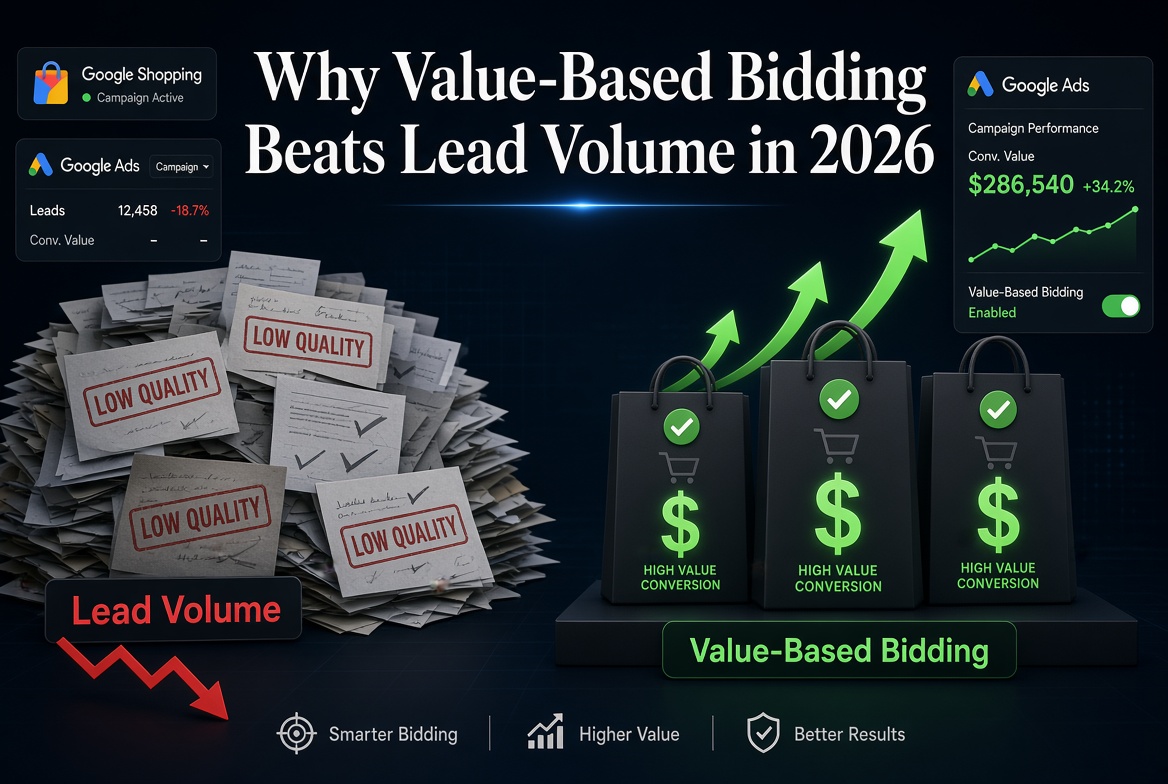
Google Ads crossed $318 billion in revenue in 2026, and global PPC spend is closing in on $306 billion. Yet despite these staggering numbers, a quiet crisis has been building inside advertising accounts everywhere: the metrics look great, but the sales teams are frustrated. Cost per lead keeps falling — and so does lead quality. The old model is fundamentally blind to profit.
Most accounts fire a single conversion the moment a form is submitted or a call connects, giving every interaction identical weight. To Google’s algorithm, a tire-kicker and a ready-to-buy customer are indistinguishable. When Maximize Conversions takes over, it does exactly what it promises — it buys the most conversions at the lowest cost. That sounds efficient until you realize it’s optimizing for quantity, not quality.
The shift to Value-Based Bidding (VBB) is the industry’s answer to this disconnect. Companies making the transition are already reporting a median 14% increase in conversion value at similar ROAS, with cost per qualified lead dropping as much as 47% and customer acquisition costs falling 30%.
The Profit Blind Spot of Cost-Per-Lead Optimization
One campaign pulls 100 leads at $50 each. Another pulls 60 at $70. By every standard dashboard metric, the first wins — until you look at what those leads actually do. If the pricier leads close at higher rates, buy premium services, or stick around longer, the math flips entirely.
That’s the trap volume-based bidding sets. When all products run in a single campaign under one ROAS target, Google’s algorithm doesn’t chase profit — it chases volume. And volume almost always means the lowest-priced, easiest-to-convert products, which are rarely the most profitable ones.
A $996 million benchmark study revealed that nearly half of brands already running value-based approaches were doing so on dirty data — meaning even early adopters are leaving money on the table.
How Value-Based Bidding Works
Maximize Conversion Value and Target ROAS work differently from standard Smart Bidding: they read the dollar amount attached to each conversion and bid accordingly. Not one unit. Not a checkbox. A number — and that number changes everything about how the algorithm allocates budget.
The math makes this concrete. A B2B company with a $3,000 average order value and 45% margin lands at $270 per lead using standard conversion values. Factor in lifetime value — customers spending an average $5,000 more over the relationship — and that same conversion is worth $720 to the algorithm. Nearly three times higher. That gap determines which leads Google chases.
Documented implementations back this up: one account saw conversion volume jump 68% while spend more than doubled year over year, yet cost per sales-accepted lead still improved 32%. VBB campaigns need at least 50 conversions with attached values within 35 days to function properly, and automated bid strategies only outperform manual bidding when the value signals fed into them are accurate.
Feed Architecture and Custom Label Strategy
Performance Max bids on the match between product feed and incoming queries — and product titles carry roughly 70% of that signal. A 40–60% expansion in paid Shopping impression share is achievable without touching bids at all, simply by tightening feed structure.
Custom labels are where the real leverage sits. Google allows five of them (custom_label_0 through custom_label_4), and most merchants leave them blank. Feed rules can update these labels automatically based on ROAS band, margin, stock level, or sale status — meaning the segmentation stays current without manual intervention. High-margin items above 50% contribution margin can run at Target ROAS of 300–400%. Low-margin products below 30% get pushed to 400%+ or manual CPC. Budget stops chasing revenue and starts chasing profit.
AdFlow’s dynamic custom labeling capabilities make this segmentation seamless, automatically categorizing products based on performance metrics and syncing directly with Google Merchant Center and Google Ads. Rather than manually updating labels across thousands of SKUs, AdFlow keeps your feed optimized in real time.
One timing detail worth knowing: feed changes take 3–7 days to propagate through auctions, but structural improvements compound — meaningful ROAS lift typically materializes over 4–8 weeks.
Stop leaving conversion value on the table — make your product feed work as hard as your bidding strategy.
Value-Based Bidding is only as smart as the data you feed it. If your Google Shopping feed is riddled with missing attributes, generic titles, and unstructured custom labels, Google’s algorithm can’t distinguish your high-margin products from your low-value ones — and your ROAS suffers for it. That’s where AdFlow comes in. As a Toronto-based AI-powered Google Shopping feed management tool built for Shopify merchants, AdFlow automatically optimizes product titles, descriptions, and missing attributes while applying performance-based custom labels in real time — giving Smart Bidding the clean, structured conversion data it needs to prioritize your most profitable products and drive measurably better results.