
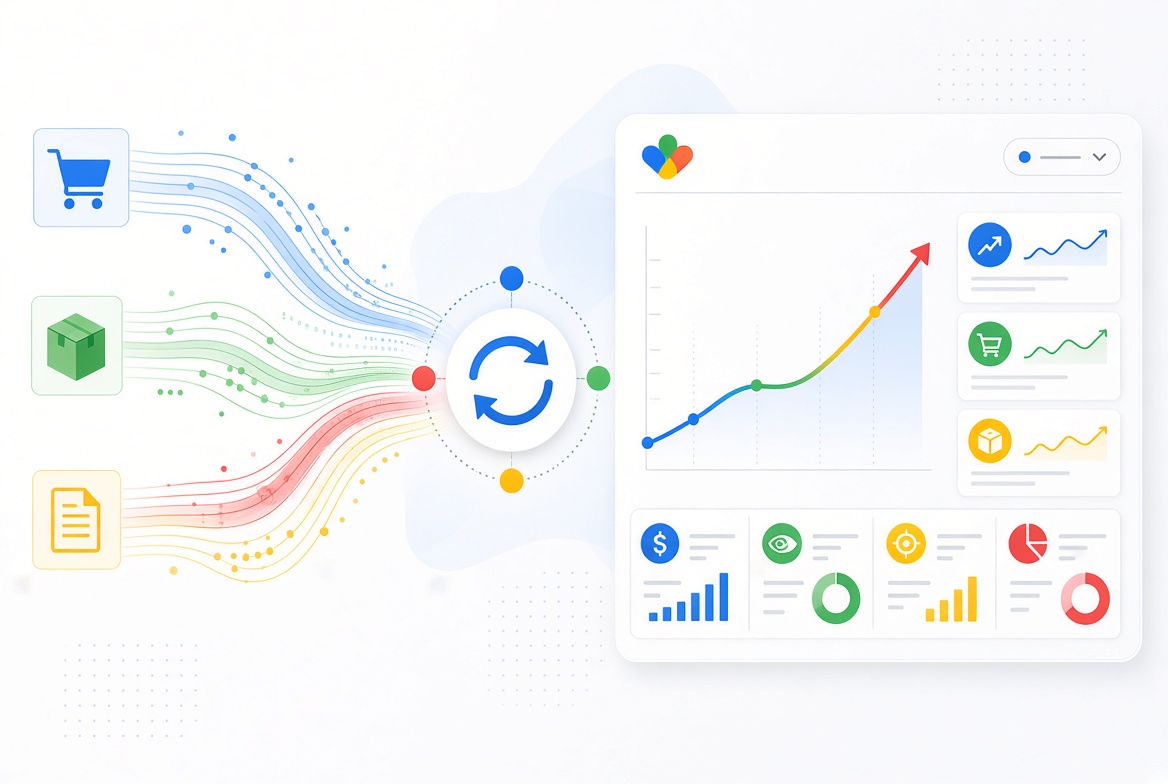
Feed-based ads account for a median of 90% of Performance Max spend, yet feed quality remains widely overlooked. Every missing attribute, vague title, and incomplete data point quietly drains your budget.
Performance Max functions much like Google Shopping under the hood: you submit your feed to Google Merchant Center, link it to your campaign, and Google uses your feed data to build ads across its inventory. With over 1 billion products competing for visibility and 36% of online shoppers starting their search on Google, product listing ads deliver a pre-qualified audience that converts about 30% better than standard text ads—provided your feed gives Google enough data to work with.
Missing Attributes and Feed Disapprovals
When attributes are missing, inaccurate, or generic, automation learns slower and scales inefficiently—costing you profit margin. Missing product data is the most common disapproval trigger in Google Merchant Center, causing items with gaps to be rejected outright or shown less frequently.
According to the Feed Marketing Report 2022, 7% of products submitted to Merchant Center are rejected due to data errors. Common culprits include price mismatches, missing required identifiers (GTIN, MPN, brand), incorrect categorization, policy violations, low image quality, and landing page issues. Products missing a GTIN or MPN suffer limited performance and may fail to sync to Merchant Center altogether.
Under Google’s stricter 2025 feed policies, minor inconsistencies can pull listings from Shopping results immediately—cutting off impressions, clicks, and sales until resolved. Overlooked attributes such as gender, size, color, and age group frequently trigger these disapprovals.
Title Optimization and Attribute Completeness
Google matches listings to search queries using feed data, and title structure represents the largest area of lost revenue. Prepend brand, append specific attributes like color and size, and keep titles under 150 characters. Product names designed for storefront display frequently fail in AI-driven discovery environments like Google Shopping or Gemini, where stylized branding provides little search context to the algorithm.
Optimized feeds deliver higher performance: roughly 34% more clicks, 41% higher ROAS, and 88% fewer ad rejections. Complete attributes and keyword-rich titles can expand impression share by 40–60% without increasing bids.
Beyond titles, attribute depth determines auction eligibility. A product categorized under Home > Decor matches far fewer relevant queries than one categorized under Home > Flooring > Carpet & Carpet Tiles. Completing fields like color, material, size, MPN/SKU, custom labels, and product type moves products into competitive impression share.
- Title tips: prepend brand, include key attributes (color, size, material), keep under 150 characters.
- Attribute priorities: GTIN/MPN/brand, product type, category, color, size, age group, material.
AI Feed Automation and Custom Labels
For stores managing 1,000+ products, manually updating titles, attributes, and pricing across spreadsheets takes 20–40 hours a week, resulting in stale data and missed auctions.
AI models analyze which title structures drive the highest click-through rates, identify the attributes Google weights for specific queries, and flag underperforming listings to update the feed in real time.
Custom labels provide granular campaign control. Tagging high-margin products, clearance inventory, or seasonal collections allows you to build dedicated PMax asset groups with targeted budgets and ROAS goals. Applying a “High Margin” label to top SKUs focuses ad spend where return is highest rather than distributing budget evenly across the entire catalog.
Streamline Your Feeds with AdFlow
As Google expands AI-powered listing verification and real-time crawl checks in 2026, AdFlow’s AI feed automation eliminates manual data entry by automatically optimizing titles, descriptions, and missing attributes through dynamic custom labeling and real-time mapping. Synced directly with Google Merchant Center and Google Ads, AdFlow detects and fills missing attributes like color and material instantly to maximize conversion rates.
Stop leaving feed performance to chance — let Google Shopping feed management work for you with Adflow.
Every stat in this article points to the same truth: your product feed is your campaign. Adflow’s AI-powered platform automatically optimizes titles, descriptions, and images to match Google’s algorithm, detects and fills missing attributes like color, material, and GTINs in real time, and applies intelligent custom labels to keep your bidding strategies updated without manual work. Fully synced with Google Merchant Center and launchable directly from your Shopify dashboard, Adflow turns an underperforming feed into a high-converting sales engine — fast.